
A riding mower makes quick work of a large lawn — until it doesn’t. A flat tire, a clogged deck, or a slipping belt turns a two-hour job into an afternoon of frustration, and the difference between a routine fix and a repair bill often comes down to the equipment sitting in your garage. If you’re planning to lift, sharpen, or service your mower safely, it helps to check this review of a mower lift before you decide what belongs on your shortlist, since lifting gear is the foundation the rest of your maintenance kit depends on. The guide below walks through the equipment categories that actually matter, what each one does, and how to match your choices to your mower and your budget.
Quick Answer
Choose riding mower maintenance equipment by starting with safety and access: a lift or jack rated well above your mower’s weight, sturdy jack stands, and wheel chocks. Then add the tools that match your regular tasks — a blade sharpening kit, a socket and wrench set, a grease gun, an oil drain pan, and a tire pressure gauge. Prioritize lift capacity, stability, and build quality over brand count. Buy fewer, better tools that fit your mower’s actual dimensions and bolt sizes rather than a large generic kit.
Key Takeaways
- Lifting equipment is the one category where under-buying creates real injury risk, so match or exceed your mower’s stated weight with a wide safety margin.
- Measure your mower’s deck width, wheelbase, and ground clearance before buying a lift or ramps, because fit matters as much as capacity.
- Core hand tools (sockets, wrenches, torque wrench) and fluid handling gear cover most routine maintenance; specialty tools come later.
- Deck leveling and blade sharpening tools pay for themselves quickly if you service the mower yourself each season.
- A cheap tool that breaks mid-job is more expensive than a mid-range tool that lasts, especially for anything load-bearing.
Start With Safety Equipment, Not Convenience Tools
The most common mistake new mower owners make is buying the fun, visible stuff first — a fancy blade sharpener, a pressure washer, a parts caddy — while skipping the equipment that keeps them out of the hospital. Riding mowers weigh hundreds of pounds, and a deck dropped on a foot or a mower that rolls off a ramp causes injuries that no savings justify, If you are upgrading your yard tools or researching engine power specifications, you might also want to check out how much hp does a zero turn have before buying your next machine.
Before anything else, budget for:
- A lift or jack rated above your mower’s weight. Capacity ratings usually include a margin, but the load on a lift isn’t static — it shifts as you move around the deck.
- Jack stands or safety locks. Never rely on hydraulics alone to hold a raised mower. Hydraulic seals fail, and a mechanical lock is what keeps the machine up if they do.
- Wheel chocks. Cheap, simple, and the single easiest way to stop a mower from rolling while you work on it.
- Safety glasses and gloves. Sharpening blades and working under a deck throw debris and cut skin.
A lift is the centerpiece here because it determines how much of the rest of your maintenance you can realistically do yourself. A dedicated lawn mower lift typically raises the front end so you can access the deck for blade removal, cleaning, and belt inspection without crawling underneath. Look at how the lift supports the mower — some cradle the front wheels or frame rails, others use a platform — and confirm it works with your mower’s frame design, not just its weight. (For a closer look at one option, you can check this review of a specific mower lift, but treat it as one data point among several.)
Ramps vs. Jacks vs. Dedicated Lifts
These three approaches solve different problems, and picking the wrong one wastes money:
| Option | Best For | Main Limitation |
|---|---|---|
| Ramps | Fast access for basic tasks like oil changes or deck cleaning | Mower must be driven or pushed up; not ideal for repeated blade work |
| Floor jack + jack stands | Owners who already have automotive gear and only occasionally lift | Requires careful placement; less stable for lateral work |
| Dedicated mower lift | Regular deck service, blade sharpening, belt replacement | Costs more; takes up storage space |
If you service the mower more than once or twice a season, a dedicated lift is usually worth it because it raises the deck to a comfortable working height and holds it there. If you lift the mower only occasionally, a floor jack and stands can work, but you’ll spend more time positioning and checking stability.
Match Your Equipment to Your Mower’s Actual Specs
Generic advice fails here because riding mowers vary enormously. A compact 30-inch deck mower and a 54-inch garden tractor have different weights, deck designs, and bolt sizes. Before you buy anything, gather a few facts from your owner’s manual or by measuring directly:
- Total weight (often listed as “dry weight” plus fuel and any attachments).
- Deck width and cutting height range, since this affects how much clearance a lift or ramp gives you.
- Wheelbase and front wheel size, which determine whether a lift’s cradle fits.
- Blade bolt size and spindle type, so you buy the right socket and blade removal tool.
- Oil and filter specifications, so you buy the correct fluid and a matching drain pan.
- Tire type and recommended pressure, since gauge range and inflation needs vary.
A common mismatch: buying a lift advertised for “most riding mowers” without checking its maximum lift height or wheel cradle width against your machine. If the cradle is too narrow, the mower is unstable; if the lift is too short, you’re still bending over to reach the blades.
The Core Hand Tool Set
You don’t need a rolling tool cabinet, but you do need the right sizes. Most riding mowers use a mix of standard and metric fasteners, so a kit that covers both is practical. At minimum, plan for:
- A socket set with extensions and a ratchet, covering the sizes used on your deck, spindles, and blade bolts.
- A combination wrench set in matching sizes.
- A torque wrench, because blade and spindle bolts have specified torque values, and guessing leads to loosening or stripped threads.
- Screwdrivers, pliers, and a putty knife or scraper for deck cleaning.
- Penetrating oil for rusted fasteners, which is common on mowers stored outdoors.
Spend more on the torque wrench and socket set than on the rest. A cheap socket that rounds a blade bolt turns a 15-minute job into an hour of extraction.
Deck and Blade Maintenance Tools
The deck is where most routine maintenance happens, and a few tools make it dramatically easier:
- Blade balancer to check that a sharpened blade is evenly ground. An unbalanced blade causes vibration and premature spindle wear.
- Blade sharpener — a bench grinder, a dedicated blade grinder, or a file and vise, depending on how often you sharpen.
- Deck leveling gauge or a simple tape measure and blocks to set the deck pitch and side-to-side levelness correctly.
- A sturdy scraper or deck brush to remove caked grass, which traps moisture and accelerates rust.
If you sharpen blades yourself, a balancer is the overlooked tool that prevents the vibration that shortens spindle and bearing life.
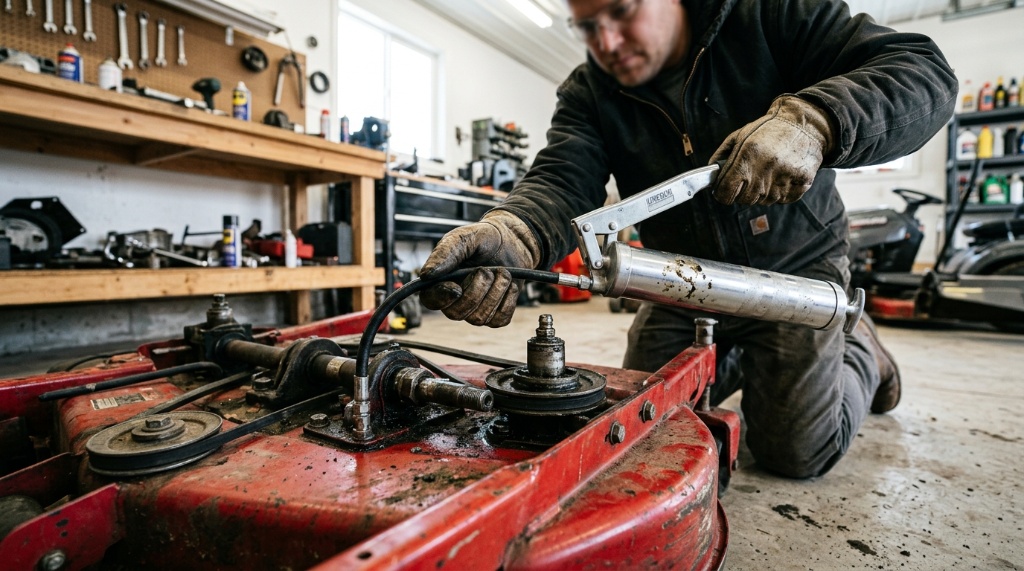
Fluid Handling and Engine Maintenance Gear
Oil changes, filter replacement, and greasing are the tasks that keep the engine alive, and they need their own equipment:
- A drain pan with enough capacity for your engine’s oil volume, plus a funnel.
- An oil filter wrench sized for your filter.
- A grease gun (manual is fine) for chassis and spindle fittings if your mower has them.
- A tire pressure gauge matched to your mower’s low-pressure tires — a standard car gauge often reads inaccurately at low PSI.
- A container for used oil, and a plan for recycling it.
Low tire pressure is a frequent, easy-to-miss cause of an uneven cut. Checking pressure before each mow, especially in cold weather when tires lose pressure faster, is one of the highest-value habits in mower ownership.
What to Skip (For Now)
New owners often overspend on tools they’ll rarely or never use. Consider postponing:
- Professional-grade hydraulic lifts if you only service the mower once a year.
- Large all-in-one mechanic tool sets with dozens of sizes you’ll never touch.
- Specialty diagnostic electronics unless you actually troubleshoot engine or electrical faults.
- Pressure washers used aggressively on decks — water forced into bearings and seals causes more harm than the dirt it removes.
Buy the tools that match your actual maintenance frequency, not an imagined future where you rebuild the engine.
How Budget Affects Your Choices
If money is tight, prioritize in this order: safety (chocks, stands, a lift if you do deck work), then engine maintenance basics (drain pan, filter wrench, gauge), then deck tools (balancer, sharpener), then convenience items. A modest, well-chosen kit beats a big, cheap one. If you’re unsure whether a specific lift or jack is worth the cost, reading an independent review — such as the one linked earlier — helps you judge real-world trade-offs instead of relying on marketing copy.
Frequently Asked Questions
What’s the minimum equipment I need to service a riding mower safely?
At minimum: wheel chocks, a lift or jack stands rated for more than your mower’s weight, safety glasses, gloves, a socket set, a drain pan, and a socket or wrench matching your blade bolts. If you plan to remove blades, add a torque wrench and a blade balancer.
Can I use a car floor jack on a riding mower?
Often yes, if the jack’s capacity exceeds the mower’s weight and you place it on a solid frame point, not the deck. Always pair it with jack stands, and never work under a mower supported only by a hydraulic jack.
Do I need a dedicated mower lift if I have ramps?
Only if you do regular deck work. Ramps are fine for oil changes and quick cleaning, but they don’t hold the mower at a comfortable working height for blade sharpening or belt replacement, and driving up them has its own risk.
How often should I sharpen mower blades?
Common guidance is every 20 to 25 hours of mowing, or whenever the cut looks ragged rather than clean. Sharpening frequency depends on your lawn’s conditions — sandy or rocky soil dulls blades faster.
Is a pressure washer safe for cleaning a mower deck?
Use low pressure and keep the spray away from bearings, seals, and the engine. High-pressure water drives grit into sealed components and can shorten their life.
How do I know what size socket my blade bolt needs?
Check your owner’s manual or measure the bolt head directly. Most riding mower blade bolts fall within common metric or standard sizes, but confirming prevents rounding a bolt with the wrong socket.
Conclusion
Choosing riding mower maintenance equipment comes down to a simple order of operations: secure the machine first with a properly rated lift, stands, and chocks; then add hand tools and fluid-handling gear that fit your mower’s actual specs; then invest in deck and blade tools if you service the mower regularly. Buy for the tasks you actually perform, verify capacity and fit before purchasing, and don’t cut corners on anything load-bearing. Start with the safety essentials this season, and add specialty tools as your maintenance routine grows.